




Beyond the 50% pain relief criterion: a minimum viable framework for interpreting spinal cord stimulation trials





Abstract
Spinal cord stimulation (SCS) is an established treatment for selected patients with chronic neuropathic pain, yet the transition from a successful temporary trial to durable implanted therapy remains clinically uncertain. Trial success is still commonly defined by at least 50% pain relief. Although clinically convenient, this threshold may overestimate the probability of sustained benefit when used as a stand-alone criterion. This article follows the methodology of an evidence-informed conceptual framework to translate existing consensus guidance into an operational structure for interpreting SCS trials. A targeted narrative synthesis of consensus guidelines, randomized controlled trials, systematic reviews and registry-based studies was performed to identify the evidence base for each proposed domain. The proposed Minimum Viable Framework (MVF) separates mandatory decision gates from supportive outcome domains and longer-term registry variables. Mandatory gates include concordance with the target pain, procedural safety and technical feasibility, and informed consent with realistic expectations. Supportive domains include pain relief, functional improvement, Patient Global Impression of Change, medication stability, psychological readiness, and patient-specific goals. The MVF is not a validated score or an access barrier. We propose it as a structured, evidence-informed method for clinical documentation, shared decision-making and future prospective validation.
Citation
Wiśniewski J, Marcinkowska A. Beyond the 50% pain relief criterion: a minimum viable framework for interpreting spinal cord stimulation trials. Eur J Transl Clin Med.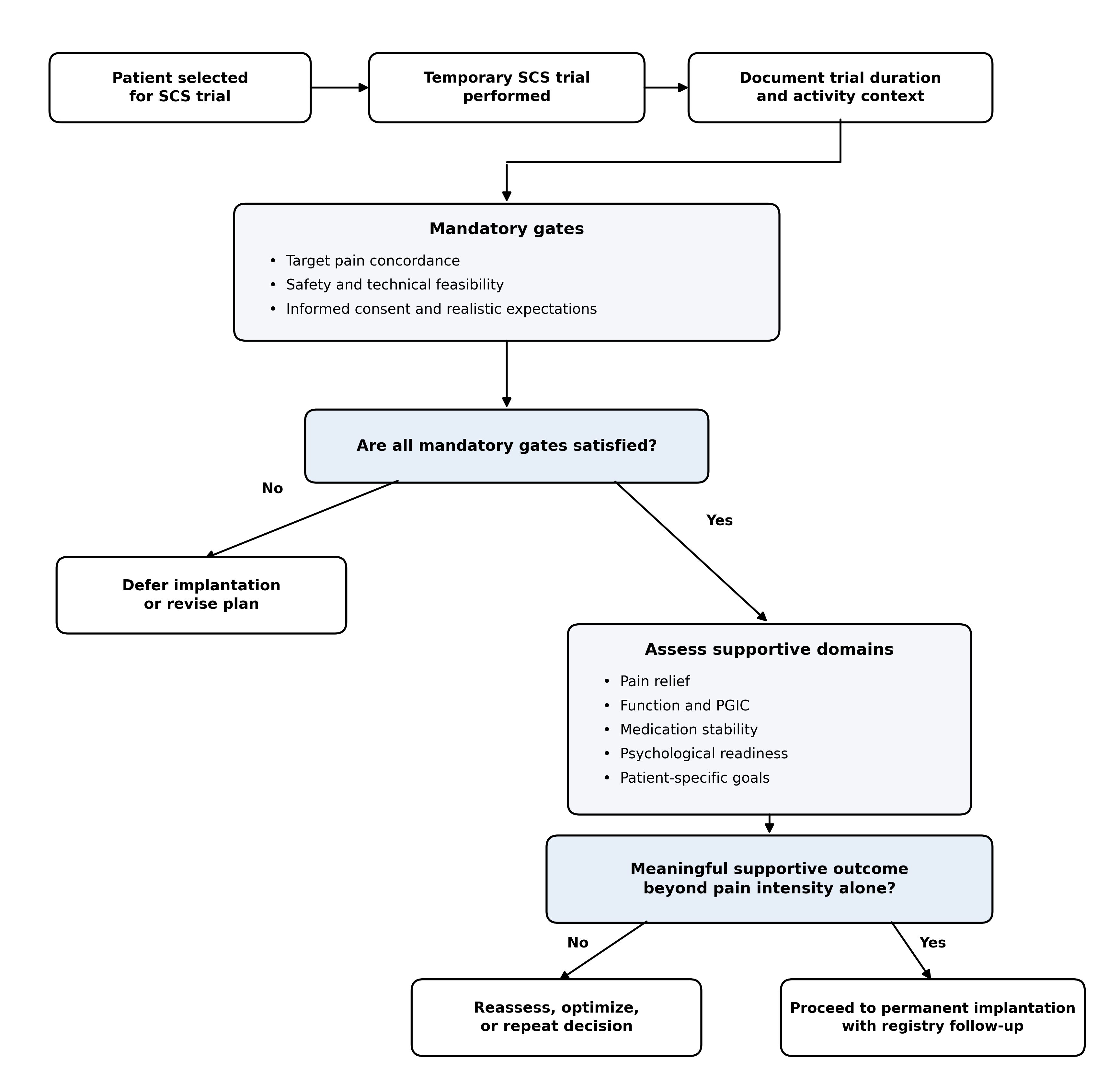



Introduction
Spinal cord stimulation (SCS) is widely used in selected patients with chronic neuropathic pain, including persistent spinal pain syndrome, radicular pain after spine surgery, complex regional pain syndrome, painful diabetic neuropathy and refractory back or leg pain. Contemporary systematic evidence, including a 2024 network meta-analysis, indicates that in several groups of patients with chronic back and leg pain SCS may improve pain and quality of life compared with conventional medical management [1]. Interpretation remains limited by heterogeneity in indications, stimulation paradigms, comparators, follow-up duration and risk of bias. A 2023 Cochrane systematic review emphasized that long-term comparative evidence remains incomplete in some populations, particularly when sham-controlled data beyond short-term follow-up are required [2].
Temporary trial stimulation (TTS) has traditionally been used to support the decision to proceed with permanent implantation. In routine practice, trial success is often reduced to a single threshold: ≥ 50% reduction in pain intensity. This criterion is widely used in clinical studies and reimbursement pathways. Its simplicity also makes it understandable for patients, clinicians and payers. This simplicity may obscure clinically relevant uncertainty. A short trial may be influenced by expectation, reduced activity, procedural context, temporary lead positioning, increased clinical attention, and short-term behavioral adaptation. It may not adequately capture functional recovery, medication stability, psychosocial risk, durability of benefit, technical feasibility, long-term programming burden, or the probability of revision or explantation.
Multidimensional assessment in SCS is not a new concept. The 2023 evidence-based consensus guidelines on patient selection and TTS for SCS in chronic non-cancer pain emphasize patient selection, psychological assessment and careful interpretation of TTS [3]. IMMPACT recommendations for chronic pain trials also support outcome assessment across multiple domains [4-5]. A core set of patient-reported outcome measures was proposed for patients treated with SCS or dorsal root ganglion stimulation [6].
Existing recommendations do not provide a concise, minimum viable, registry-ready structure for documenting whether a short-term SCS trial response is sufficiently meaningful to justify permanent implantation. This article addresses that gap using an evidence-informed conceptual framework, a recognized scientific approach for translating existing evidence and clinical consensus into operational structures when primary data collection or systematic review is not the stated objective [7]. The framework distinguishes mandatory decision gates, supportive outcome domains, longer-term registry variables and situates each domain within the current evidence base for TTS.
Material and methods
This is a narrative clinical review and conceptual framework, following the methodology of evidence-informed conceptual frameworks as applied in clinical guideline development and implementation science [7]. This approach is appropriate when the objective is to synthesize existing evidence and consensus guidance into an operational clinical structure, rather than to generate new primary data or perform a systematic evidence synthesis. Conceptual frameworks developed by this method are recognized as hypothesis-generating instruments that precede and inform prospective validation studies [7]. The methodology follows established approaches for narrative synthesis in clinical practice guidelines and expert consensus papers [3].
A targeted literature search was performed in PubMed and Google Scholar up to April 2026. Search terms included combinations of: “spinal cord stimulation”, “trial stimulation”, “patient selection”, “50% pain relief”, “Patient Global Impression of Change”, “PGIC”, “IMMPACT”, “PROMIS”, “Oswestry Disability Index”, “EQ-5D”, “psychological screening”, “catastrophizing”, “explantation”, “neuromodulation registry” and “real-world outcomes”. Priority was given to consensus guidelines, randomized controlled trials, systematic reviews, registry-based studies, and publications addressing patient-reported outcomes or psychological assessment in SCS. The objective was to identify clinically relevant evidence supporting a practical structure for trial interpretation, not to perform a systematic review or meta-analysis. No formal risk-of-bias assessment, quantitative synthesis, or GRADE certainty-of-evidence grading was performed, consistent with the conceptual framework design. Because the search was exploratory and iterative rather than systematic, the number of records (retrieved, screened and excluded) was not recorded and no PRISMA-style flow diagram is presented.
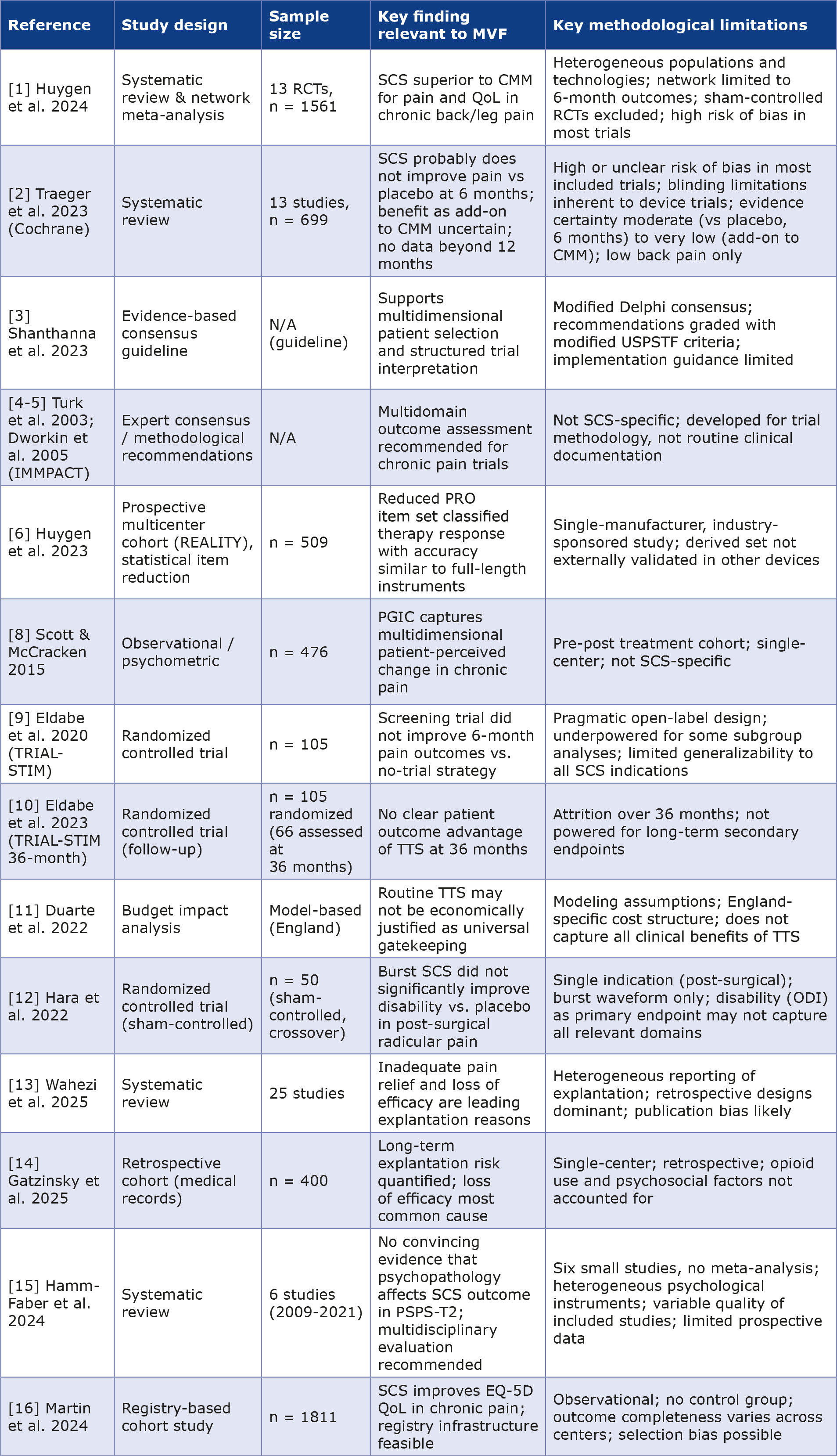
The framework was developed through a structured process: (1) identification of existing evidence-based recommendations on SCS trial interpretation and patient selection; (2) identification of gaps between existing guidance and operational clinical documentation needs; (3) synthesis of domains supported by empirical evidence or consensus guidance; and (4) translation into a minimum dataset applicable to routine practice and compatible with registry infrastructure. A summary of key references (including study design, sample size, key finding, and principal methodological limitations) is presented in Table 1. This summary does not constitute a formal risk-ofbias assessment but is intended to allow readers to judge the strength and applicability of the evidence underlying each MVF domain.
Table 1. Strength of evidence summary supporting the MVF
Note: This table does not constitute a formal risk-of-bias assessment (e.g. Cochrane RoB 2, ROBIS).
It is provided as a structured evidence summary to support transparent interpretation of the clinical and methodological context of each reference. Consensus documents and methodological recommendations are not subject to standard risk-of-bias tools and are listed here for the sake of completeness.
CMM – conventional medical management, DRG – dorsal root ganglion, MVF – minimum viable framework, ODI – Oswestry Disability Index, PGIC – Patient Global Impression of Change, PRO – patient-reported outcome, QoL – quality of life, RCT – randomized controlled trial, SCS – spinal cord stimulation, TTS – temporary trial stimulation
AI-based language and drafting assistance was used during manuscript preparation and editing. The authors verified the clinical interpretation, references, intellectual content and the final draft.
Results
Persistence and limitations of the 50% pain relief criterion
The 50% pain relief threshold has practical advantages: it is simple, reproducible in routine documentation, easy to communicate and compatible with binary clinical (and reimbursement) decisions. The limitation appears when this threshold substitutes for broader clinical judgment.
A patient may report 50% pain relief during a protected trial period without meaningful improvement in walking, sleep, daily activity, medication use or global perception of benefit. Conversely, a patient with < 50% pain reduction may experience clinically relevant functional improvement and a favorable global assessment of change. IMMPACT recommendations caution against reliance on pain intensity alone when interpreting chronic pain outcomes because other factors (e.g. function, emotional status, patient global improvement, symptoms, adverse events and treatment continuation) all contribute to the interpretation of clinical benefit [4-5]. Patient Global Impression of Change (PGIC) is particularly useful because it captures whether the patient perceives the overall change as meaningful [8].
In SCS, this broader approach is particularly relevant because permanent implantation establishes a long-term therapeutic relationship with an implanted device. The post-trial decision should not be framed solely around whether pain intensity decreased by 50%. A more clinically relevant question is whether the trial provides sufficient evidence that permanent implantation is likely to deliver meaningful, durable, acceptable and technically feasible benefit.
Trial stimulation as an imperfect prognostic test
The clinical utility of TTS has been questioned in randomized and economic analyses. In the TRIAL-STIM randomized controlled trial (n = 105), a screening trial strategy did not provide superior pain outcomes at 6 months compared with a no-trial strategy in patients with chronic neuropathic pain [9]. The 36-month follow-up similarly did not demonstrate a clear patient outcome advantage of TTS [10]. Budget impact analyses have raised related concerns about whether routine TTS is economically justified as a universal gatekeeping step [11].
These findings do not eliminate the clinical value of TTS, as it may still help assess tolerability, early analgesic response, paresthesia coverage (when relevant), patient engagement, procedural feasibility and short-term adverse events. The available evidence does challenge the interpretation of TTS as a precise diagnostic test for durable long-term benefit. TTS may be more useful as a structured decision-making process than as a binary prognostic test. Such reframing is central to the rationale for the MVF: if TTS is a decision-making process rather than a diagnostic test, the documentation of that process should reflect its multidimensional nature.
Limitations of short-term trial response as a predictor of durable benefit
A positive trial does not necessarily translate into durable benefit after implantation. TTS duration is usually short, whereas chronic neuropathic pain is shaped by activity, sleep, mood, medication use, social context, and disease fluctuation. Trial conditions also differ from normal life: patients are often advised to restrict flexing, twisting, and excessive movement to reduce the risk of temporary lead displacement. Pain relief observed during this protected period may therefore overestimate benefit once ordinary activity resumes.
Technological heterogeneity further complicates interpretation. Tonic, high-frequency, burst, differential target multiplexed and closed-loop SCS all differ in patient experience, programming strategy, paresthesia profile and evidence base. Network meta-analysis suggests benefit of SCS over conventional medical management in chronic back and leg pain, but these estimates pool heterogeneous populations and technologies [1]. Sham-controlled evidence has also challenged assumptions in selected populations. Hara et al. reported that burst SCS did not significantly improve disability compared with placebo stimulation in patients (n = 50) with chronic radicular pain after lumbar spine surgery [12].
Technical durability is another determinant of long-term outcome. Permanent implantation may fail because of lead migration, infection, pocket pain, hardware malfunction, discomfort, loss of efficacy or patient preference. Explantation is a clinically meaningful endpoint and should not be treated as an administrative detail. Recent systematic reviews and longterm analyses identify inadequate pain relief and loss of efficacy as frequent reasons for explantation [13-14].
Psychological and behavioral factors may also influence both trial interpretation and long-term satisfaction. Unrealistic expectations, anxiety, catastrophizing, sleep disturbance, coping style, depression and substance use can affect reported benefit and engagement with therapy. A systematic review of data from 2009 to 2021 found no convincing evidence that the presence of a psychopathological disorder affects SCS outcome in PSPS type 2 and recommended multidisciplinary psychological evaluation as part of comprehensive assessment and treatment optimization [15].
The Minimum Viable Framework for trial interpretation
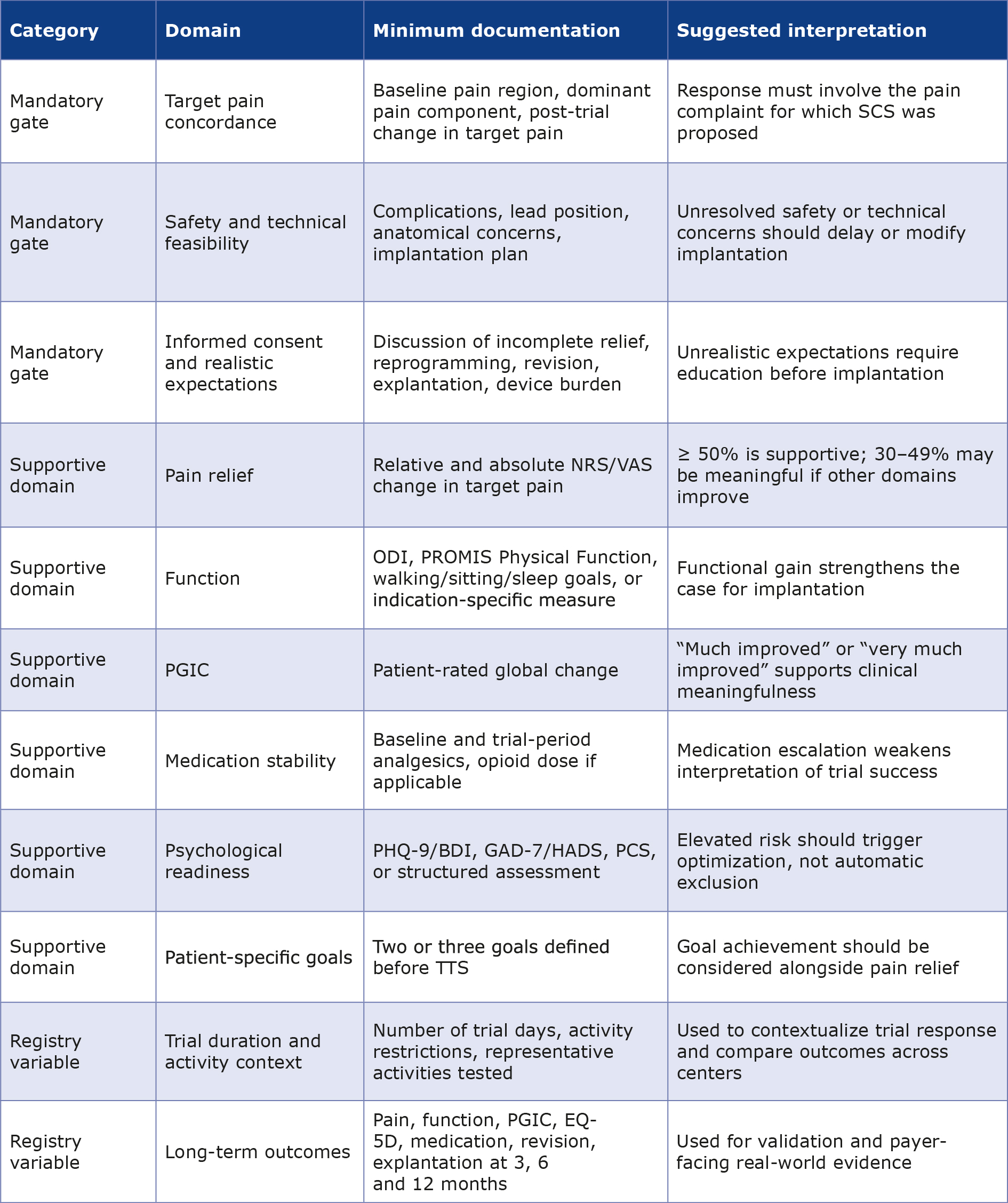
The proposed framework separates 3 components: mandatory decision gates, supportive outcomes, and registry variables for longer-term validation. This structure is intended to avoid reduction of trial success to pain intensity alone while preserving feasibility in routine clinical settings (Table 2 and Figure 1).
Table 2. Minimum Viable Framework for interpreting SCS trials
Decision rule: Permanent implantation should generally require all three mandatory gates to be satisfied: target pain concordance, safety and technical feasibility, and informed consent with realistic expectations. At least one clinically meaningful supportive outcome beyond pain intensity alone should also be present. This rule is intended to structure clinical reasoning, not to function as a rigid eligibility algorithm.
Trial-duration note: Trial duration should be recorded and interpreted as a contextual modifier. Short trials may underestimate or overestimate benefit if the patient cannot test stimulation during representative activities. Longer trials may provide more time for functional assessment but may also increase temporary-lead burden and complication risk.
BDI – Beck Depression Inventory, EQ-5D – EuroQol five-dimension questionnaire, GAD-7 – Generalized Anxiety Disorder-7, HADS – Hospital Anxiety and Depression Scale, NRS – Numeric Rating Scale, ODI – Oswestry Disability Index, PCS – Pain Catastrophizing Scale, PGIC – Patient Global Impression of Change, PHQ-9 – Patient Health Questionnaire-9, PROMIS – Patient-Reported Outcomes Measurement Information System, SCS – spinal cord stimulation, VAS – Visual Analogue Scale
Figure 1. Proposed decision pathway for interpreting spinal cord stimulation trial response using the minimum viable framework. Permanent implantation should generally require concordance with the target pain, safety and technical feasibility, informed consent with realistic expectations, and at least one clinically meaningful supportive outcome beyond pain intensity alone. The pathway is intended to structure clinical reasoning and documentation, not to function as a rigid eligibility algorithm.
Abbreviations: PGIC – Patient Global Impression of Change, SCS – spinal cord stimulation
Permanent implantation should generally require satisfaction of all mandatory gates and at least 1 clinically meaningful supportive outcome beyond pain intensity alone. Trial duration should be documented as a contextual variable rather than treated as a universal determinant of success. A very short trial may be insufficient to assess stimulation during representative daily activities, whereas a prolonged trial may increase the burden of temporary leads, restrictions, infection risk and lead displacement. The MVF should therefore be interpreted in relation to trial duration, activity level and the degree to which stimulation was tested under clinically meaningful conditions.
Mandatory decision gates
Target pain concordance requires that the trial response involve the dominant pain complaint for which SCS was proposed. Improvement in a secondary or less disabling pain component should not be treated as equivalent to meaningful improvement in the target pain. Minimum documentation should include baseline pain distribution, target pain region, dominant pain phenotype and post-trial change in the target pain.
Safety and technical feasibility require explicit assessment of factors that may influence permanent implantation. Relevant variables include epidural anatomy, lead stability, anticoagulation, infection risk, body habitus, implantable pulse generator pocket tolerance, ability to comply with postoperative restrictions and feasibility of revision if needed. Specific technical barriers should be documented when present, including difficult epidural access, epidural fibrosis, prior multilevel surgery, severe spinal stenosis or lead positions that may be difficult to reproduce during permanent implantation. Such findings do not necessarily preclude implantation, but they should modify the operative plan and interpretation of trial reliability.
Informed consent and realistic expectations require that the patient understands SCS as a long-term management strategy rather than a curative intervention. Consent should include discussion of incomplete pain relief, reprogramming, charging burden (when relevant), MRI limitations, lead migration, infection, hardware discomfort, revision surgery, loss of efficacy, and possible explantation. Unrealistic expectations should prompt education, expectation alignment or delayed implantation.
Supportive outcomes
A reduction of at least 50% in target pain remains clinically useful. However, 30% to 49% pain reduction may still be meaningful when accompanied by functional improvement, favorable PGIC, stable medication use and realistic expectations. Pain should be documented both as relative reduction and absolute post-trial score. Persistent target pain of 4/10 or higher might be acceptable for some patients if function, sleep, PGIC and medication stability improve, but it should prompt additional discussion rather than automatic progression to implantation.
Functional change should be documented prospectively. The IMMPACT framework identifies physical function as a core outcome domain in chronic pain trials [4-5]. Practical options include the Oswestry Disability Index for low back and leg pain patients, disease-specific functional goals, walking tolerance, sitting tolerance, sleep duration, return to rehabilitation or ability to perform self-care. Centers with established outcome infrastructure may use the PROMIS Physical Function or EQ-5D. Each center should predefine one minimal functional measure appropriate for its case mix and workflow.
PGIC should be included whenever feasible because it is brief, understandable and captures whether the patient perceives the overall change as meaningful [8]. A response of “much improved” or “very much improved” may support implantation when aligned with pain and function. PGIC should complement (not override) safety, technical feasibility and informed consent.
Medication stability should also be documented. Trial success should not be attributed to SCS if pain relief coincides with analgesic dose escalation, rescue medication, or sedatives. Baseline and trial-period medication use should be recorded, including morphine milligram equivalents when opioids are used.
Consistent with the 2023 consensus guidelines and a 2024 systematic review on psychopathological disorders and SCS outcomes, psychological readiness should be understood as risk identification and optimization rather than punitive clearance [3, 15]. Practical tools include PHQ-9 or Beck Depression Inventory (for depressive symptoms), GAD-7 or Hospital Anxiety and Depression Scale (for anxiety), Pain Catastrophizing Scale and structured clinical assessment for expectations, coping style, substance use, suicidality and untreated severe psychiatric instability. Elevated scores should prompt education, expectation alignment, psychological support or delayed implantation (when the risk factors are modifiable).
Patient-specific goals should be defined before TTS. Examples include walking a defined distance, sleeping through most of the night, sitting long enough to travel, reducing rescue medication, resuming rehabilitation or performing a specific daily activity. Trial interpretation should include whether these predefined goals were achieved.
Application across SCS paradigms
The domains of meaningful trial success should remain largely waveform-independent, but their interpretation may differ by technology. In paresthesia-based tonic SCS, concordant paresthesia coverage, paresthesia tolerability and positional variation remain clinically relevant. In paresthesia-free paradigms (e.g. high-frequency or burst stimulation) paresthesia mapping is less informative. Greater emphasis should therefore be placed on predefined functional goals, PGIC, medication stability, and delayed assessment of benefit. In closed-loop SCS, device-derived variables may complement patient-reported outcomes. These data may support programming and mechanistic interpretation, but they should not replace patient-centered assessment. The decision to implant should remain grounded in patient-relevant improvement.
Payer and health-system relevance
A minimum viable framework may also be useful for payers and health systems. Its purpose is not to create additional barriers to SCS, but instead to document that implantation is supported by patient-centered benefit, functional relevance, technical feasibility and an appropriate follow-up plan. This issue is relevant because TTS consumes procedural resources and may not always improve long-term outcomes compared with direct implantation strategies [9-10]. Structured documentation may help distinguish patients in whom TTS contributes to clinical decision-making from those in whom it functions mainly as a procedural requirement.
From a reimbursement and health technology assessment perspective, the MVF may provide a more transparent justification for implantation than a single pain-intensity threshold. Documentation of target pain concordance, safety, informed consent, functional relevance, PGIC, medication stability and planned follow-up may strengthen reimbursement dialogue by showing that the decision is not based solely on subjective NRS/VAS change. Data from the UK and Ireland National Neuromodulation Registry illustrate the feasibility of using quality-of-life data such as EQ-5D in large SCS cohorts, thus supporting the registry component of the MVF [16].
This framework should not be converted into a rigid administrative barrier. Its value for payers is in improving quality and comparability of documentation, not in multiplying exclusion criteria. Registry-compatible domains such as EQ-5D, ODI, medication use, revision and explantation may support real-world evaluation of value.
Implications for clinical practice and research
Positioning within analogous clinical frameworks
The challenge of translating short-term trial response into a durable implantation decision is not unique to SCS. Analogous structured frameworks have been developed in other implantable neuromodulation fields. In deep brain stimulation (DBS) for Parkinson’s disease, pre-surgical patient selection integrates motor response to levodopa challenge, neuropsychological assessment, psychiatric comorbidity screening and multidisciplinary team review, none of which is reducible to a single threshold. In cochlear implantation, assessment incorporates audiological testing, speech perception outcomes, device experience during trial fitting, psychological readiness and realistic expectation counseling before commitment to surgery. In sacral neuromodulation for overactive bladder, a mandatory percutaneous nerve evaluation or stage-I implant trial is followed by multidimensional assessment of voiding diary outcomes, patient-reported satisfaction and technical feasibility before stage-II implantation is offered.
Across these fields, the shared principle is that a shortterm physiological or symptomatic response is necessary but not sufficient to justify permanent implantation. Structured decision frameworks (not single numeric thresholds) are the standard of care. The MVF proposed here applies the same principle to SCS, translating existing consensus guidance into an operational minimum dataset consistent with the broader trajectory of implantable neuromodulation practice.
Clinical implications
The proposed framework may improve routine SCS practice by making the post-TTS decision more transparent and defensible. Clinicians can explain why permanent implantation is recommended or deferred without relying exclusively on a single pain score. This is particularly relevant in cases where the 50% threshold is borderline, where trial conditions were atypical or where functional and psychological factors complicate interpretation. For shared decision-making, the MVF provides a structured basis for the discussion with the patient about the domains that improved (or did not) and what this implies for long-term expectations. Patients who understand that implantation is being recommended on the basis of functional gain, medication stability and a favorable PGIC (not a pain score alone) may be better prepared for the long-term management demands of an implanted device. For centers developing or revising SCS programs, the MVF offers a minimum dataset that can be implemented without specialist psychometric infrastructure. The mandatory gates are documentable in any clinical setting. The supportive domains can be captured with instruments endorsed by existing guidelines [3, 6]. The registry variables require only that existing outcome data be structured consistently over time.
Research agenda
The MVF generates several testable hypotheses for future prospective research. First, a pragmatic registry study could capture MVF domains at baseline, trial completion, implantation and follow-up at 3, 6 and 12 months. The primary validation question would be whether satisfaction of mandatory gates plus at least one supportive domain beyond pain intensity predicts durable benefit, lower revision burden, lower explantation risk, medication stability and patient satisfaction better than the 50% pain relief criterion alone. Second, inter-rater reliability of mandatory gate assessment should be evaluated across clinician types (pain physicians, neurosurgeons, specialist nurses) and center sizes. If concordance is high, the MVF could be integrated into multicenter registries with reasonable confidence in data comparability. Third, the relative predictive weight of individual supportive domains warrants prospective investigation. It is currently unknown whether PGIC, functional change, or medication stability is the strongest independent predictor of long-term SCS success. A registry with complete MVF documentation at trial completion could address this question and potentially allow future refinement of the framework into a weighted or scored instrument. Fourth, patient acceptability of the MVF process (including predefined goal-setting and psychological screening) should be formally evaluated. Qualitative and mixed-methods studies could identify which components patients find valuable, burdensome or unclear.
Limitations
This article proposes a conceptual and operational framework rather than a validated scoring system. Several limitations warrant explicit acknowledgment. First, the literature search was targeted rather than systematic. No formal riskof-bias or GRADE assessment of the evidence was performed. The framework is therefore based on selected evidence, consensus concepts, and clinical reasoning. This approach is consistent with the objective of operationalizing existing guidance, but it means that the strength of evidence underlying individual domains varies and has not been formally quantified. Second, universal minimum clinically important difference (MCID) thresholds are not provided for every domain. This is intentional: SCS populations are heterogeneous and functional tools should be selected according to indication and local feasibility. A universal threshold could create false precision. Third, the framework has not been tested for inter-rater reliability, predictive validity, or acceptability among patients, clinicians and payers. These represent necessary next steps before broader implementation. The MVF is presented as a structured hypothesis, not as a validated clinical instrument. Fourth, the framework does not address the question of whether TTS should be mandatory at all. The TRIAL-STIM evidence raises legitimate questions about the clinical utility of a screening trial as a universal gatekeeping step [9-10]. The MVF is intended to improve how trials are interpreted when performed, not to resolve the broader question of whether TTS is always indicated.
Conclusions
This narrative review addresses an operational gap by synthesizing the evidence base for multidimensional trial interpretation and proposing a minimum viable framework (MVF) that distinguishes mandatory decision gates, supportive patient-centered outcome domains and registry variables. The MVF is consistent with analogous structured decision models (e.g. deep brain stimulation, cochlear implantation, sacral neuromodulation) and is grounded in the IMMPACT outcome recommendations and SCS-specific consensus guidance. The MVF is not a validated score, but a structured, evidence-informed hypothesis requiring prospective validation. Until such validation is available, the MVF can already serve its primary purpose: making the post-trial implantation decision more structured, defensible and patient-centered.
Acknowledgements
None.
Funding
No external funding was received for this work.
Conflicts of interest
Both authors declare no conflicts of interest related to this manuscript.
AI assistance disclosure
AI-based language and drafting assistance was used to support language refinement. Both authors remain fully responsible for the concept of the article, clinical interpretation, accuracy of references, intellectual content and its final version.
References
| 1. |
Huygen FJPM, Soulanis K, Rtveladze K, Kamra S, Schlueter M. Spinal Cord Stimulation vs Medical Management for Chronic Back and Leg Pain. JAMA Netw Open [Internet]. 2024;7(11):e2444608. Available from: https://jamanetwork.com/journals/jamanetworkopen/fullarticle/2826172.
|
| 2. |
Traeger AC, Gilbert SE, Harris IA, Maher CG. Spinal cord stimulation for low back pain. Cochrane Database Syst Rev [Internet]. 2023;2023(8). Available from: http://doi.wiley.com/10.1002/14651858.CD014789.pub2.
|
| 3. |
Shanthanna H, Eldabe S, Provenzano DA, Bouche B, Buchser E, Chadwick R, et al. Evidence-based consensus guidelines on patient selection and trial stimulation for spinal cord stimulation therapy for chronic non-cancer pain. Reg Anesth Pain Med [Internet]. 2023;48(6):273–87. Available from: https://rapm.bmj.com/lookup/doi/10.1136/rapm-2022-104097.
|
| 4. |
Turk DC, Dworkin RH, Allen RR, Bellamy N, Brandenburg N, Carr DB, et al. Core outcome domains for chronic pain clinical trials: IMMPACT recommendations. Pain [Internet]. 2003;106(3):337–45. Available from: https://www.ovid.com/00006396-200312000-00014.
|
| 5. |
Dworkin RH, Turk DC, Farrar JT, Haythornthwaite JA, Jensen MP, Katz NP, et al. Core outcome measures for chronic pain clinical trials: IMMPACT recommendations. Pain [Internet]. 2005;113(1):9–19. Available from: https://www.ovid.com/00006396-200501000-00005.
|
| 6. |
Huygen F, Hagedorn JM, Falowski S, Schultz D, Vesper J, Heros RD, et al. Core patient-reported outcome measures for chronic pain patients treated with spinal cord stimulation or dorsal root ganglia stimulation. Health Qual Life Outcomes [Internet]. 2023;21(1):77. Available from: https://hqlo.biomedcentral.com/articles/10.1186/s12955-023-02158-2.
|
| 7. |
Ferrari R. Writing narrative style literature reviews. Med Writ [Internet]. 2015;24(4):230–5. Available from: http://www.tandfonline.com/doi/full/10.1179/2047480615Z.000000000329.
|
| 8. |
Scott W, McCracken LM. Patients’ Impression of Change Following Treatment for Chronic Pain: Global, Specific, a Single Dimension, or Many? J Pain [Internet]. 2015;16(6):518–26. Available from: https://linkinghub.elsevier.com/retrieve/pii/S1526590015005441.
|
| 9. |
Eldabe S, Duarte R V., Gulve A, Thomson S, Baranidharan G, Houten R, et al. Does a screening trial for spinal cord stimulation in patients with chronic pain of neuropathic origin have clinical utility and cost-effectiveness (TRIAL-STIM)? A randomised controlled trial. Pain [Internet]. 2020;161(12):2820–9. Available from: https://journals.lww.com/10.1097/j.pain.0000000000001977.
|
| 10. |
Eldabe S, Nevitt S, Griffiths S, Gulve A, Thomson S, Baranidharan G, et al. Does a Screening Trial for Spinal Cord Stimulation in Patients With Chronic Pain of Neuropathic Origin Have Clinical Utility (TRIAL-STIM)? 36-Month Results From a Randomized Controlled Trial. Neurosurgery [Internet]. 2023;92(1):75–82. Available from: https://www.ovid.com/10.1227/neu.0000000000002165.
|
| 11. |
Duarte R V., Houten R, Nevitt S, Brookes M, Bell J, Earle J, et al. Screening trials of spinal cord stimulation for neuropathic pain in England—A budget impact analysis. Front Pain Res [Internet]. 2022;3. Available from: https://www.frontiersin.org/articles/10.3389/fpain.2022.974904/full.
|
| 12. |
Hara S, Andresen H, Solheim O, Carlsen SM, Sundstrøm T, Lønne G, et al. Effect of Spinal Cord Burst Stimulation vs Placebo Stimulation on Disability in Patients With Chronic Radicular Pain After Lumbar Spine Surgery. JAMA [Internet]. 2022;328(15):1506. Available from: https://jamanetwork.com/journals/jama/fullarticle/2797419.
|
| 13. |
Wahezi S, Yener U, Naeimi T, Lewis J, Yerra S, Sgobba P, et al. Spinal Cord Stimulation Explantation and Chronic Pain: A Systematic Review and Technology Recommendations. J Pain Res [Internet]. 2025;Volume 18:1327–40. Available from: https://www.dovepress.com/spinal-cord-stimulation-explantation-and-chronic-pain-a-systematic-rev-peer-reviewed-fulltext-article-JPR.
|
| 14. |
Gatzinsky K, Brink B, Eyglóardóttir KL, Hallén T. Long-term explantation risk in patients with chronic pain treated with spinal cord or dorsal root ganglion stimulation. Reg Anesth Pain Med [Internet]. 2025;50(12):923–9. Available from: https://rapm.bmj.com/lookup/doi/10.1136/rapm-2024-105719.
|
| 15. |
Hamm-Faber TE, Vissers KCP, Kalkman JS, van Haren FGAM, Aukes HJA, Engels Y, et al. The Predicted Outcome of Spinal Cord Stimulation in Patients With a Psychopathological Disorder and Persistent Spinal Pain Syndrome Type 2: A Systematic Review From 2009 to 2021. Neuromodulation Technol Neural Interface [Internet]. 2024;27(1):59–69. Available from: https://linkinghub.elsevier.com/retrieve/pii/S1094715923009820.
|
| 16. |
Martin SC, Baranidharan G, Thomson S, Gulve A, Manfield JH, Mehta V, et al. Spinal Cord Stimulation Improves Quality of Life for Patients With Chronic Pain—Data From the UK and Ireland National Neuromodulation Registry. Neuromodulation Technol Neural Interface [Internet]. 2024;27(8):1406–18. Available from: https://linkinghub.elsevier.com/retrieve/pii/S1094715924006469.
|
